I was dropping Ravi home on my bike when he mentioned that he’d soon be moving to a new home. Before shifting, he wanted to throw a house party bidding farewell to his current studio. To be honest, I had assumed it would be a simple get-together—a handful of friends, Ravi strumming Bollywood melodies on his guitar, and some fast food with cold drinks. For any Nepali youngster, that’s about as good as it gets.
I was wrong. Ravi is a rockstar. A rockstar who makes folk music.
Two days later, I received an invitation to an event called Shaam-ah-Awadh. The poster, the words in the invitation, Ravi’s meticulous dress-code instructions—everything sparked excitement. What is he planning? Is this a mini music concert? As someone who has always admired Ravi’s music, I knew this wouldn’t be an ordinary house party. Even the name itself—Shaam-ah-Awadh—hinted at the level of dedication behind it. I had never heard of anyone naming a house party, let alone making personalized invitations with posters! The name meant An Evening of Awadh—a tribute to the Awadhi language spoken in Nepal’s Terai and parts of India. Ravi, after all, shares the mother tongue of Lord Ram.
On Thursday, a day before the event, I was chatting with a friend who would be joining me. We both eagerly anticipated the Awadh-themed evening. On the day of the event, I prepared my kurta, just like many other guests. The event was set to begin at 4 PM, but I arrived at 4:45, worried I might have missed something special. Luckily, only three guests had arrived, seated in Ravi’s beautifully designed in-house studio.
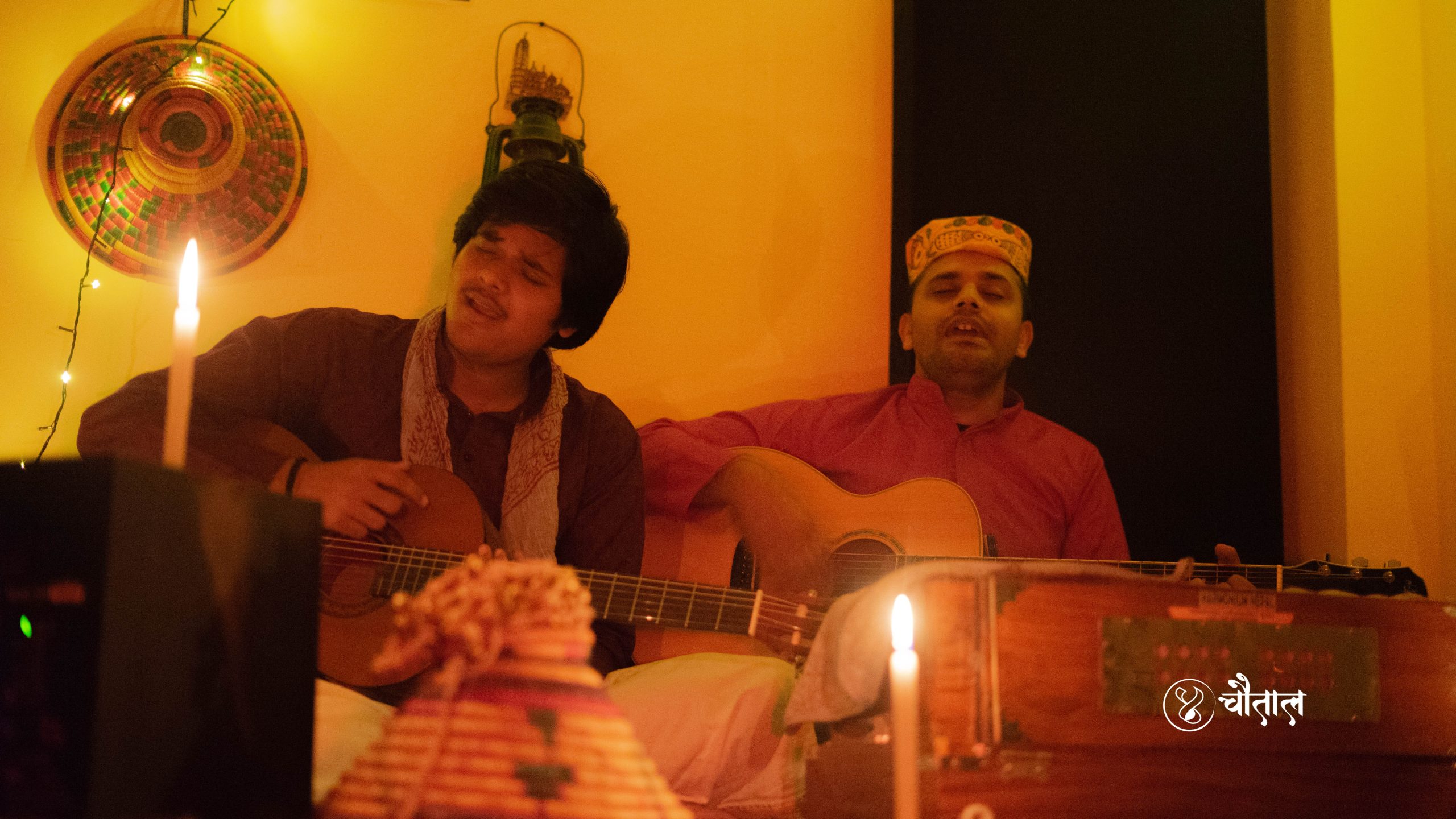
The setup felt like an intimate ghazal gathering. Both the performers and the audience sat on Nepali traditional mats, creating a cozy, cultural atmosphere. The walls were adorned with photographs from Ravi’s adventures, and the decor was steeped in the essence of the Terai. An old fire lantern, hanging just above the performers’ spot, instantly took me back to my childhood in Madhesh. The room also featured Dhakiya —bamboo and rope utensils commonly found in Terai households. Meanwhile, Ravi, his brothers, and a few friends were busy preparing dinner—something we hadn’t even anticipated.
The musical evening began an hour and a half later than planned. The audience settled in, facing a makeshift stage encircled by warm string lights. Ravi took his seat alongside Rupesh Bhaiji, his co-performer. (Bhaiji—a Maithili term for elder brother.)
As the guitar was being tuned, Rupesh Bhaiji started singing on his harmonium:
“Aaju, Mithila nagariya nihaal sakhiya.
Chaaru dulha mein badka kamaal sakhiya.”
He was describing the grand moment from the Ramayana when Janakpur was beautifully decorated for Princess Sita’s wedding, and Lord Ram arrived, looking majestic. The way he sang felt like a brother singing for his beloved sister. There couldn’t have been a more melodious start to the evening.
Then, Ravi took over. His song, “Arey sambhal chalo sajni, dhunhal na ho chunari,” painted a vivid picture of women’s lives in South Asian villages. The ambience—or as we like to say, the ‘Maahol’—was set.
As the night progressed, the event turned into a feast for the ears and a symphony for the heart. We refused to let them stop—so much so that Rupesh Bhaiji and Ravi had to perform five encore ghazals before we finally let them rest.
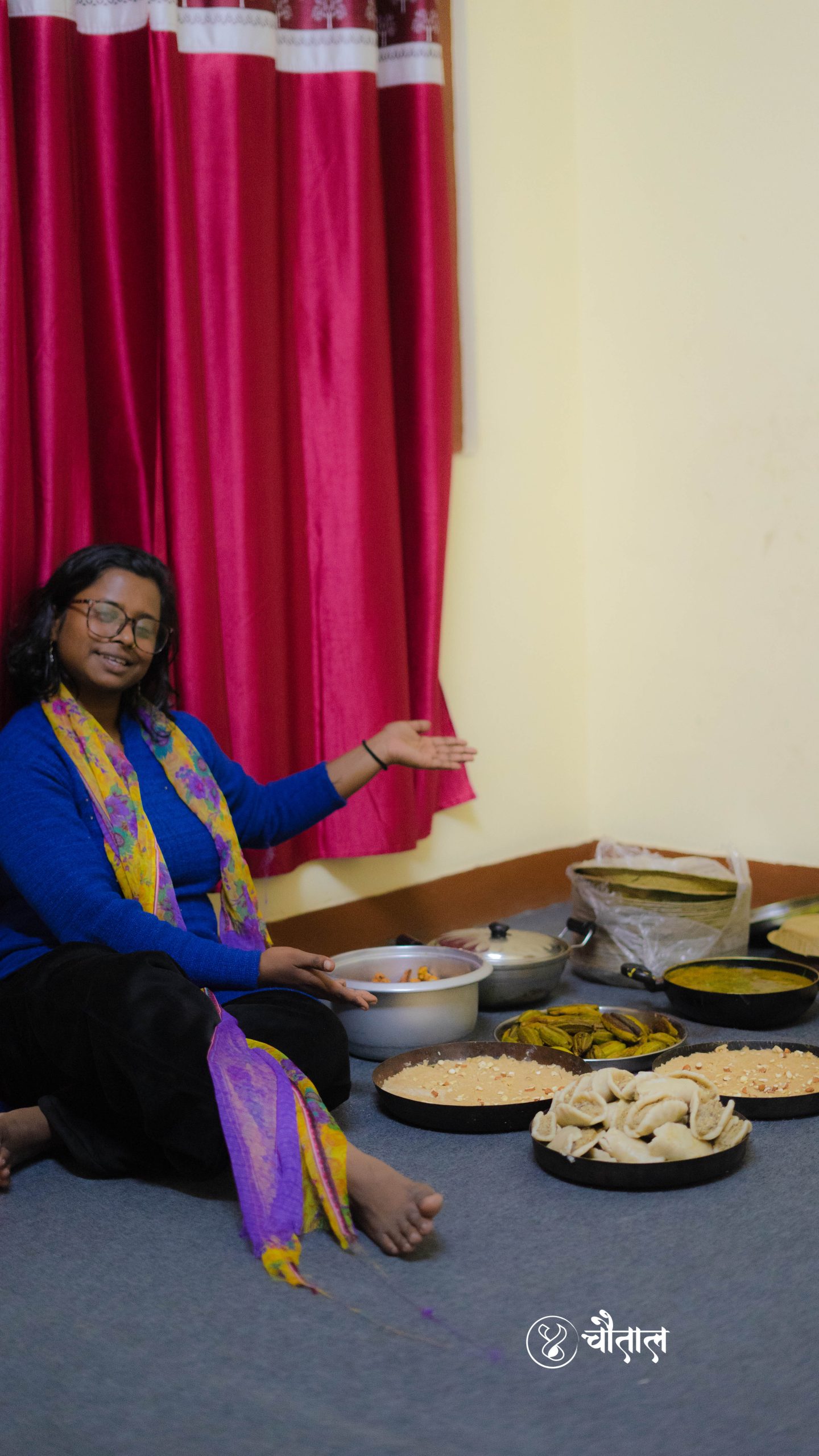
Still enchanted by the magic of Shaam-ah-Awadh, we moved to another room for dinner. The setup was reminiscent of a traditional Terai bhoj—guests sitting cross-legged on mats in a circle, gossiping as they ate. Our gracious host had arranged plates and bowls made from leaves, a traditional touch that made the experience even more authentic.
Soon, food from the heart of Madhesh began filling our plates—Paratha, Bharua, Gattha(Singada) Sabji, Haluwa, Fara , and Pakoda—all lovingly prepared by Ravi’s cousins and friends. Between bites, we listened to fellow guests recite poetry and shayaris, adding another layer of artistry to the evening.
It was more than a house party. It was an experience. An immersion into culture, music, and heartfelt storytelling. And I was lucky to be a part of it.